Catching My Baby Dust

OL_Catching My Baby Dust Cover FINAL_DrHelena-01.png

I am extremely pleased and excited to announce the arrival of my book: “Catching My Baby Dust’, which came to a reality after many months of hard work. This book consist of inspiring true stories on the journeys couples had been through in trying to have a baby. Many of these stories detailed the trials and tribulations of their Fertility journeys. These stories are deeply touching and in many ways humbled me as a Fertility Specialist.

Here is the small note I have written for the publication of this book:

Welcome to the first edition of ‘Catching My Baby Dust’.  As the Chief Editor of this book, I would like to thank you for taking your time to read this special book, which is extremely close to my heart.


As a Fertility Specialist, I have the opportunity to work with women who are from various backgrounds, ethinicities &  educational levels. They have one thing in common: They all want to have a baby.


As a mother of three, I can fully understand their desire to have these little bundle of joy in their arms, and how these tiny little babies would complete and fulfill their lives. However, the reason that they are sitting in my clinic is that pregnancies did not happen naturally, and therefore they are here to seek guidance and assistance.


I must say that I feel privileged that I can do something to help them. My greatest pleasue of my daily life is to help these patients to identify the issues which prevent them from conceiving naturally and rectify their problems. Some need just a little bit of reassurance and things happenned.  Unfortunately, some need much more than reassurance. And the good news is that most will eventually have a baby in their arms following fertility treatments.


Throughout these journeys, I have come across many women who had deeply touched me with their perserverance and determination which greatly humbled me. Some of these stories bring tears to my eyes and I hereby express my greatest gratitude to them by agreeing to share their stories with people out there who are trying to conceive.


I would like to thank my senior colleague, Dato Dr Prashant Nadkarni, the Medical Director of KL Fertility Centre for his valuable input. My co-editors, Dr Natasha Ain Mohd Nor & Dr Agilan Arjunan, who shared my passion in the field of fertility and had worked fervently in making this book a reality.


I would like to take this opportunity to thank Ms Sylvia Khoo, the director of Pitter Patter Sdn Bhd, Ms Adline A Ghani and Ms Lee Siew Fong helped us to co-ordinate the production of this book.

Last but not the least, I would like to thank all the readers for their constructive comment to further improve the quality of this book.


Dr Helena Lim Yun-Hsuen

Editor

Catching My Baby Dust


干杯之后, 好孕灰飞烟灭-风采杂志

FEMININE alcohol

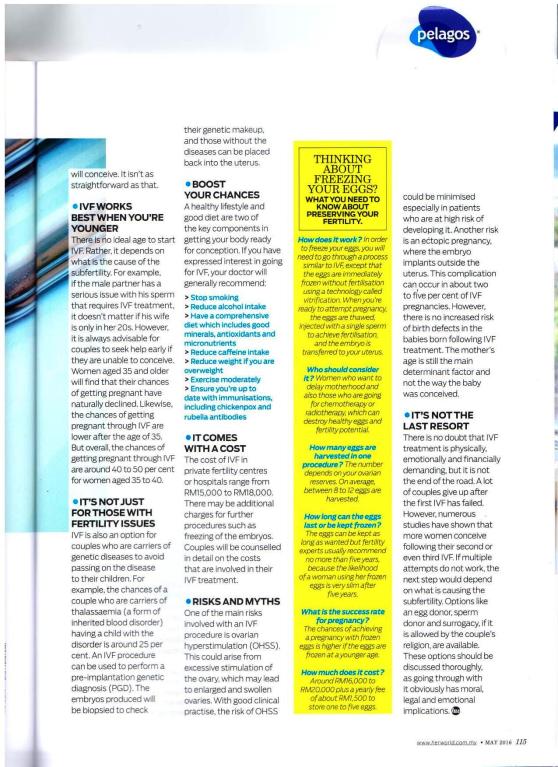
Contemplating IVF? Her World Magazine

Her World - May Issue - Dr. helena and Dr. Natasha0001


Her World - May Issue - Dr. helena and Dr. Natasha0002

The dairy seesaw

download

The dairy seesaw

How dairy may lower or increase your risk for infertility and miscarriage

Dairy is a good source of calcium, protein, vitamin D and phosphorus, which is why pregnant women are often advised to include dairy in their diet. After all, these nutrients are essential for a baby’s developing bones, teeth, muscles, heart and nerves. However, some studies have shown that some dairy products can be good for you, while others can be bad. So before you reach for that glass of milk or bowl of ice cream, let’s weigh the pros and cons of dairy.

The Pros

According to an eight-year Harvard study involving around 18,000 women, the moderate consumption of high-fat dairy products like ice cream, whole milk, yogurt and cheese is considered fertility and pregnancy friendly. This is because whole milk contains a complete protein that is important for egg quality. Their findings showed that dairy could reduce the risk of anovulatory infertility by more than 50%. and lower the risk of miscarriage by 33%.

Meanwhile, another study by the Laboratory of Experimental Endocrinology, University of Crete, School of Medicine, Heraklion, Greece, has found that dairy may reduce the body’s unwanted immune response, which secretes antibodies that affect the fetus and can cause recurrent miscarriages.

The Cons

While the moderate intake of dairy is beneficial, the high consumption of milk has been linked to a decrease in fertility. This is because excess protein intake (more than 120 grams a day) can cause embryo implantation problems. In addition, women with dairy intolerance and allergies are more likely to miscarry.
However, many people are unaware that they are lactose intolerant. According to the Physicians Committee of Responsible Medicine, 75% of the world’s population is lactose intolerant. A study published by the European Journal of Obstetrics, Gynecology, and Reproductive Biology (2001) also found that eating butter and oil can double a woman’s risk for miscarriage.


What about low fat dairy?

It is known that full-fat dairy foods contain the female hormones estrogen and progesterone. But when fat is skimmed from the milk, the process removes these hormones and leaves behind male hormones or androgens, which impairs ovulation. The same Harvard study mentioned above found that low fat dairy can increase the risk of ovulatory infertility by 85%.

Milk and hormones

While we’re on the subject of hormones, it is important to note that because animal milk contains hormones, high intake of dairy may disrupt your own hormonal balance. Some of the fertility issues that can be associated with hormone imbalance are PCOS, Endometriosis and male infertility.

A study conducted by researchers from the Cancer Epidemiology Centre, The Cancer Council Victoria, Melbourne, Australia has found that women who eat high amounts of dairy can have 15% higher estrogen levels, which may influence circulating concentrations of estradiol. Estradiol is a form of estrogen that while is necessary for many processes in the body can also cause harm to pregnancy and unborn babies.

images

Milk and inflammation

In traditional Chinese medicine, dairy is believed to be ‘damp’ and cause inflammation, which hampers fertility and causes problems in getting pregnant. However, in Western medicine, several studies have been found that dairy can help reduce inflammation.

For example, researchers from the Department of Nutrition and Biochemistry, School of Public Health, Tehran University of Medical Sciences, Iran discovered that probiotic yogurt can lower one marker of inflammation by 29%.

A similar study by the Department of Nutrition Science-Dietetics, Harokopio University, Athens, Greece also identified an inverse association between dairy products consumption and levels of various inflammatory markers among healthy adults. They found that dairy lowers inflammatory markers by as much as 16%.

These findings are supported by another study by the Department of Nutrition, University of Tennessee, Knoxville, USA, which found that calcium and dairy consumption can reduce tissue oxidative and inflammatory stress.

From the findings above, we can conclude that the moderate consumption of whole dairy products is beneficial to fertility and pregnancy. However, if you’re feeling uncertain, don’t take the drastic step of cutting dairy out of your diet completely. Instead, speak to your fertility consultant about how much dairy you should be consuming.


对抗氧化压力-风采杂志

Article (Dr Helena) (3)

运动影响受孕率-风采杂志

article - Dr helena 0002.jpg-Exe

针灸提高试管活产率-风采杂志

article - Dr helena 0001.jpg-Acu

Our IVF Journey

One of the most important lesson that I have learnt from my mentor in IVF is that IVF is equivalent to an exam. The likelihood of passing an exam (aka. achieve a pregnancy) is increased if you are prepared for it. Half of the battle is won not during the battle itself but during the preparation for the battle.

As a seasoned student (I have been through many exams including my professional exams), I could not agree more. A famous Chinese military general, strategist and philosopher, Sun Tzi (600 B.C.), who authored the famous book ‘the Art of War’ had clearly illustrated and emphasized the importance of being ‘prepared’ as the secret of a victory.

Therefore, before you embark on your journey of IVF, would you join the wining team by preparing yourself for the battle?

unnamed

Our-Journey-Chinese-150605-back-590x834


The benefits of acupuncture in IVF

woman acupuncture at the back (small)


Restoring balance

The benefits of acupuncture in IVF

In recent years, acupuncture has become an increasingly popular complementary treatment for those suffering from infertility, especially women undergoing IVF treatment. But what’s behind the buzz and does it actually work? Let’s examine the known facts.

What is acupuncture?

Acupuncture is a form of traditional Chinese medicine (TCM) and healing method that has been used for thousands of years across the world to treat a variety of ailments. It involves the gentle insertion of thin, sterile needles that are inserted into the skin at strategic points of the body to provide stimulation.

According to TCM practitioners, there are more than 2,000 acupuncture points on the human body, which are connect to 14 major pathways or meridians. These meridians conduct “qi,” which is a form of energy or life force that is believed to regulate our spiritual, emotional, mental and physical balance. Poor health habits can disrupt the proper flow of qi, leading to various ailments, including pain and infertility.

 53

Benefits for those undergoing IVF

As acupuncture works on the principle of restoring balance, here’s how it can help:

Reduces stress – By lowering the levels of stress hormones released into the blood stream, acupuncture can help restore the body’s hormonal and neurochemical balance.

Improves blood flow – Stimulation at strategic points can increase blood flow to the ovaries and uterus, which increases chances for the egg to be implanted, nourished and carried to term.

Relieves aches – By alleviating existing aches and pains, acupuncture can provide further relief and stress reduction.

Relieves anxiety – By helping to treat conditions like anxiety and insomnia, which can have devastating long-term effects to wellbeing, acupuncture helps restore the body’s delicate balance.

Few side effects – Unlike some forms of Western treatment, which can be invasive and causes undesirable side effects, acupuncture has relatively few to no side effects other than causing bruising at the needle site.

Balance-Girl


Scientific research

Some experts in complementary medicine have cautioned that the positive effects of acupuncture may actually be due to a “placebo effect” that is caused by patients expecting acupuncture to work. To understand the phenomenon better, some scientific studies have been carried out to review the benefits of acupuncture in infertility treatments.

One study, jointly-conducted by the University of Maryland’s School of Medicine, Georgetown University School of Medicine, Washington and the University of Amsterdam, Holland, compared the results of needle acupuncture in women receiving IVF, against women who received fake treatments and no treatments at all.

The results were very positive, as according to the study, “IVF with acupuncture increased the odds of pregnancy by 65% (according to early evidence on ultrasound), increased the odds of ongoing pregnancy by 87% (according to ultrasound evidence of pregnancy at 12 weeks) and increased the odds of a live birth by 91% compared with IVF on its own.”

 acupuncture-preg

Conclusion

The researchers concluded that their results suggest that, “Acupuncture given with embryo transfer, improves rates of pregnancy and live birth in women who are undergoing in vitro fertilisation.” While their findings are significant and clinically relevant, the researchers consider them to be “somewhat preliminary” and call for further investigation in the link between pregnancy rates and the effect of acupuncture.

With these encouraging facts and figures, there is no wonder why more and more couples are choosing to include acupuncture in their infertility treatment routine. If you’re interested to find out more about using acupuncture as a complementary form of treatment, don’t hesitate to bring it up to your doctor.


A-CartoonDiscountAcu

妈妈宝宝杂志 – 求孕之路6

MengSee-1 MengSee-2 MengSee-3 MengSee-4