Nature or nurture?

Watson-Crick-DNA-model

Professor Watson & Crick, who unlocked the secret of DNA & Genes


A journalist who came to interview me a few years ago asked me a question: ‘What makes you become interested in reproductive science and inspired you to become a Fertility Specialist?’


I was quite taken aback by this question. I knew where this question was coming from: Being a daughter of a Professor in Chinese Literature, one who had thought that I would end up in field related to Sociology, Literature or Humanity. A doctor and a Fertility Specialist from such family, hmmm….an unlikely species.


I searched my mind long and hard, everyone who knew me knows that I have a passion for literature and social science. But why reproductive science? And why Fertility?

The answer became clear suddenly: I have the privilege to know a couple who was my parents’ neighbours and friends, whom I have have fondly called Uncle Chong Lek & Aunty Sam. This couple are both Professors in the field of Genetics. At the age of 9, I used to  listen to Uncle Chong Leh and Aunty Sam, who came to join us for a meal or a tea, and shared on their field of research and findings. I was fascinated and in awe, even at the tender age of 9.

IMG_9443

Professor Koh Chong Lek & Professor Sam Choon Kook

How fascinating it is that we are governed by our genes which determined how we look like or  the colour of our skin? How did these DNA coding became the essential aspect of life forms ?

At that time, we have not discovered the secret of nurture versus nature in modifying our gene expression.

As I progressed in pursuing my acaedemic advancement, I find myself becoming more and more inclined to science related subjects. I was, genetically inclined to arts, but an exposure to this lovely couple had altered my genetic expression…..I became who I am, a doctor, then a Gynaecologist and then a Fertility Specialist, who works closely with scientists. Being involved in Fertility work, my practice is closely related to understanding of chromosomes and genes.


Nature or nurture?

An introduction to epigenetics

Many people believe that children are more the product of nurture than nature, meaning that the environment in which a child is brought up in has a greater effect on his or her well-being, personality and traits than the child’s genes. Yet, there are those who believe that a child’s inherent nature can’t be changed, despite the amount of nurturing received. Now, however, this debate has become academic, enter – epigenetics.

What is epigenetics?

Epigenetics is a new and complex science that looks at how lifestyle and environmental factors can affect a baby’s genes. In particular, it studies how the millions of markers in our genes can change our traits at a cellular and physiological level. Although the sequence of the genes we’re born with can’t be changed, it is believed that the way that they’re activated or expressed can be altered – for better or for worse. Furthermore, it is possible that these traits can then be passed down by an individual through the generations.

How it affects IVF patients

Most IVF patients who receive donated eggs and sperm feel that their baby won’t be taking much after them, as they don’t share the same DNA. However, according to epigenetics, this doesn’t have to be the case. In epigenetics, factors such as the uterine environment, stress levels and pregnancy diet can have a direct influence on the way that a baby’s genes are expressed. Therefore, in epigenetics, it is thought that IVF patients have a degree of control over how their egg/sperm-donor child might turn out, if they adopt healthy lifestyle choices.

But can the IVF procedure itself cause negative epigenetic consequences? According to a small Danish study conducted in 2010, it is possible. The study suggested that, “Babies born via assisted reproduction (i.e. IVF) had a slightly higher chance of getting childhood cancer.” As alarming as it sounds, the study was inconclusive and the risk appears to be minimal at best.

The importance of eating well

Through the decades, scientists have established a link between a healthy maternal diet and the well-being of babies. However, the effects can also be seen in reverse. For example, during the Dutch famine of 1944, thousands died of malnutrition due to Nazi blockades and a prolonged and harsh winter. The babies born during this period were not only underweight, but their genes were damaged.

Decades later, the Dutch Famine Birth Cohort Study would reveal that the offspring of children who were born during the famine were equally susceptible to being underweight and contracting illnesses like diabetes, obesity, cardiovascular disease and microalbuminuria. It is as if their genes had been ‘programmed’ with the adverse effects of malnutrition.


A greater power

Although epigenetics is yet to be scientifically proven, it certainly offers promise. True, it can’t be said for certain that the positive lifestyle changes you adopt before and during pregnancy can influence your baby’s genes. However, science notwithstanding, parents who have struggled to conceive possess a greater, innate power that rivals nature itself – love. And this love, coupled with positive thinking, has been known to conquer and surmount the greatest of odds.


Food for Pregnancy

SHK_0820


Some of you may have known that one of my interest in the field of Fertility is the impact of Nutrition on Fertility & Pregnancy.

Some of the research work which I am involved in surrounds this unique aspect of Fertility.

Recently, I was invited to speak to a group of O& G and Paediatric doctors on this topic. The most interesting thing is that I was asked to speak on a platform erected on a beach and my dress code was white and a flower in my hair!!!! So, the picture above was definitely NOT a singing contest but a actual scientific lecture.

I had lots of fun researching for the talk and here is some of the interesting findings I wish to share about Nutrition and Pregnancy:

The Importance of Nutrition
Lessons from the Dutch Famine Birth Cohort Study

In this post, I’ll discuss another topic related to fertility and nutrition – the findings of the Dutch Famine Birth Cohort Study. Prior to the study, very little was known about the role and effects of a maternal diet on a baby’s health. However, using the medical records collected during the famine, scientists have been able to measure the adverse effects of fetal malnutrition.


Background of the Study

The Dutch famine of 1944, also known as “Hunger winter,” was a famine that took place in the Nazi-occupied part of the Netherlands. Affecting some 4.5 million people, the famine was caused by the shortage of food supplies in the Netherlands towards the end of World War II. Although the Allied Forces had liberated the south, their efforts to free the western parts of the Netherlands were repeatedly thwarted, worsening the situation.

This was followed by the Nazi embargo on all food transport to western Netherlands and the onset of an unusually early and harsh winter. During the period, which lasted until the Allies liberated the area in May 1945, rations were as low as 400-800 calories a day. This is less than a quarter of the recommended adult caloric intake. Though estimations vary, as many as 22,000 people are believed to have died due to the famine.


The findings

The Dutch Famine Birth Cohort Study was conducted by the departments of Clinical Epidemiology and Biostatistics, Gynecology and Obstetrics and Internal Medicine of the Academic Medical Centre in Amsterdam, in collaboration with the MRC Environmental Epidemiology Unit of the University of Southampton in Britain. They based their study on the antenatal and maternity records of babies born at the Wilhelmina Gasthuis in Amsterdam between November 1943 and February 1947. The first results of the study were published in 1976 and the study is still ongoing.

Here is a summary of some of their findings:

  1. The children of pregnant women exposed to famine were more susceptible to diabetes, obesity, cardiovascular disease, microalbuminuria and other health problems.
  2. The children were smaller and their children were also thought to also be smaller than average.
  3. Early gestation appeared to be the most vulnerable period.
  4. Children affected in the second trimester of their mother’s pregnancy had an increased incidence of schizophrenia and neurological defects.
  5. Famine exposure in utero causes transgenerational effects.
  6. The effects of famine varied according to its timing during gestation, especially during critical periods of organ and tissue development.
  7. Undernutrition during any period of gestation is associated with reduced glucose tolerance and raised insulin concentrations at age 50 and 58.
  8. People exposed to famine in mid gestation had an increased prevalence of obstructive airways disease.

The most well-known survivor of the Dutch famine is perhaps Audrey Hepburn. Often admired for her gamine figure, Hepburn spent her childhood in the Netherlands during the famine. Throughout her life, she suffered from a series of health problems, including anemia, respiratory illnesses, edema and clinical depression, which were attributed to the malnutrition suffered in her early years.


download

Conclusion
The Dutch famine study has shown us that poor maternal nutrition during gestation can have detrimental effects on the health of children and even subsequent generations. Therefore, we cannot ignore the importance of maternal nutrition during pregnancy, especially in preventing chronic degenerative diseases in future generations. We must also be wary of the possible detrimental consequences of undernourishment in mothers due to unbalanced diets, rigorous fasting and severe morning sickness, especially during the first trimester.

Get Some Sun!

download


The link between Vitamin D and fertility

Caucasian women love showing off a sun-kissed tan, so much so they would dedicate a good portion of their holidays to sunbathing. We Asian women, however, are the exact opposite, preferring to keep out of the sun, sometimes taking considerable pains to do so. This aversion to the sun is largely due to the desire to maintain a fair complexion, but is driven in part by concerns over harmful UV rays. This penchant for shunning the sun, however, has had an undesirable side effect on Asian women, as we are known to have lower levels of Vitamin D despite living in tropical climates.

Few people realise that vitamin D plays a significant role, not only in their general health, but their fertility as well. It has been shown that people living in countries with strong seasonal contrasts have always had fewer pregnancies during winter and more in summer, resulting in a baby boom around spring. Scientists have discovered that this ebb and flow has to do with exposure to the sun.

Over the years, this link between Vitamin D and fertility has been extensively investigated, but it has been further detailed in a systemic review published in 2012 by the European Journal of Endocrinology. The review, by Elisabeth Lerchbaum and Barbara Obermayer-Pietsch from the Medical University of Graz, Austria, assessed studies that evaluated the relationship between vitamin D and fertility in women and men, as well as in animals.

Here’s what the review, entitled ‘Vitamin D and fertility: a systematic review,’ found:

  1. Vitamin D receptors (VDR) and vitamin D metabolising enzymes are present in the reproductive tissues of both men and women.
  2. Laboratory mice deprived of VDR tend to suffer significant gonad (sex gland) insufficiency, decreased sperm count and motility, and abnormalities in the microscopic structure of tissues in the testis, ovary and uterus.
  3. Vitamin D is involved in female reproduction including IVF outcome (clinical pregnancy rates) and polycystic ovary syndrome (PCOS).
  4. In PCOS women, vitamin D supplementation might improve menstrual frequency and metabolic disturbances.
  5. Vitamin D might influence steroidogenesis of sex hormones (estradiol and progesterone) in healthy women.
  6. In men, vitamin D is positively associated with semen quality and androgen status.
  7. Vitamin D treatment might increase testosterone levels.

While the results are encouraging, the researchers emphasise that vitamin D supplementation alone can’t improve fertility issues. However, what is certain is that it is a safe and inexpensive treatment that can be a boon to conception. So if you’re trying to conceive, don’t shy away from the sun! Instead, aim to get about 15 minutes of sun each day and take care not to overexpose yourself to UV rays.

In my next post, I’ll be discussing another topic related to fertility and nutrition – the findings of the Dutch Famine Birth Cohort Study. Stay tuned!


Food for Fertility

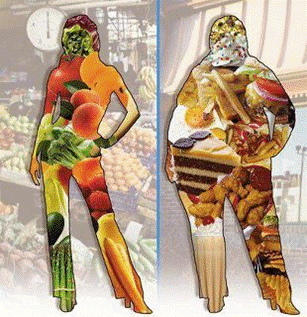
you-are-what-you-eat


The importance of micro-nutrients to conception

The adage goes, “You are what you eat,” and the same is true for fertility. But when you’re trying to conceive, you want to rely on much more than just an old saying. Statistics show that around 11% to 20% of couples experience subfertility. Of this, 10% can be classified as unexplained infertility, while 60% are classified as anovulatory subfertility. In my experience, couples today also find their infertility issues compounded by their hectic lifestyles.

Factors such as stress; unhealthy body weight; excessive smoking, alcohol and caffeine intake; exposure to toxins, as well as recreational drug use, can all play a role in affecting fertility. But even those who maintain a healthy weight, manage their stress and abstain from unhealthy habits may neglect a very important factor – nutrition. Fortunately, there is now hard evidence in the form of scientific proof that shows you can indeed improve your fertility by eating right, particularly by including micro-nutrients in your daily diet.

While macro-nutrients, like protein, unsaturated fats and carbohydrates can be easily obtained from the foods that you eat, micro-nutrients like vitamins, minerals and trace elements are often left out due to an unbalanced and unhealthy diet. Realising that micro-nutrient deficiencies are not uncommon in women of reproductive age, Dr Rina Agrawal, a consultant and associate professor in reproductive medicine and obstetrics/gynaecology at the University Hospital at Warwick University, conducted a study on the role of micro-nutrients in improving pregnancy rates.

The study, which involved 58 suitable candidates consisting of subfertile women with an average age of 32.3 years (range 19–40), investigated whether subfertile women undergoing ovulation induction using standard treatment regimens have higher pregnancy rates when given multiple micro-nutrient (MMN) nutritional supplements, as compared with folic acid alone. The findings of the pilot study unveiled that the women on MMN supplementation had a higher pregnancy rate of 66.7%, as compared with 39.3% for those on just folic acid.

This therefore suggests that additional MMN supplementations, such as vitamins B6, B12, folates, vitamin E, multivitamins, iron, zinc, copper and selenium, does improve female fertility. In addition to finding that the women on MMN supplementation had a higher chance of pregnancy compared to their peers, the women on MMN supplementation also required significantly fewer attempts to become pregnant, as compared with women on folic acid. But there are also other benefits to taking MMN supplements, including reduced reproductive risks ranging from infertility to miscarriage, and fetal structural defects to improved embryogenesis or placentation.

You may need only small amounts of micro-nutrients, but they are no doubt essential. Each vitamin and mineral plays a specific role in ensuring that your bodily systems function in top form, and needless to say they are vital to your overall wellbeing. In order to get more micro-nutrients from your daily diet, you should eat a wide variety of foods from the different food groups. It is also best to avoid eating fast foods and processed foods that are of low nutritional quality. Instead, opt for fresh fruits and vegetables, legumes, nuts and seeds, whole grains, lean meats, fish and low-fat dairy products.

Stay tuned to find out more about foods that can boost fertility.


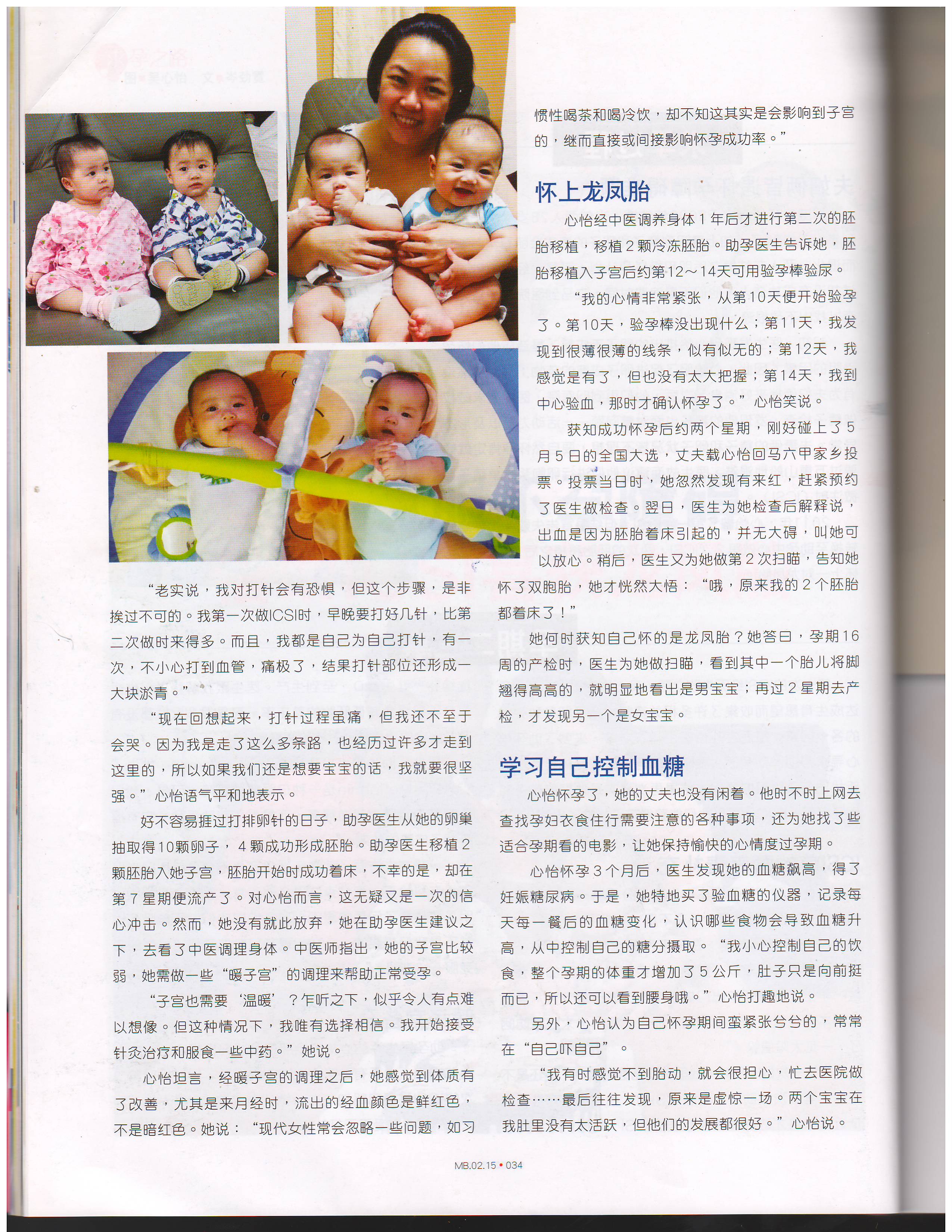
妈妈宝宝杂志 – 求孕之路6

MengSee-1 MengSee-2 MengSee-3 MengSee-4

MyEndosis Walk: Stand Up, Speak Up, Let’s Unite

Are you suffering from Endometriosis and do not know what to do and where to turn to?

Here is some good news:

Selangor and Kuala Lumpur Endometriosis Association (MyEndosis) will be holding an event called ‘MyEndosis Walk: Stand Up, Speak Up, Let’s Unite’ on  28 March 2015 from 7.30am to 11am. The venue is at Concourse area JayaONE,  Jalan Universiti, Petaling Jaya & PC 203, Faculty of Creative Industries, UTAR, No 3, Jalan 13/6, 46200, Petaling Jaya.

Come and join us to stand up and unite against endometriosis

Endo Walk

Speaker - Dr Helena Lim (2)

Speaker -Dr Natasha Ain Mohd Nor

恭喜你,成功受孕了!- 风采杂志

Dr H Feb 2